
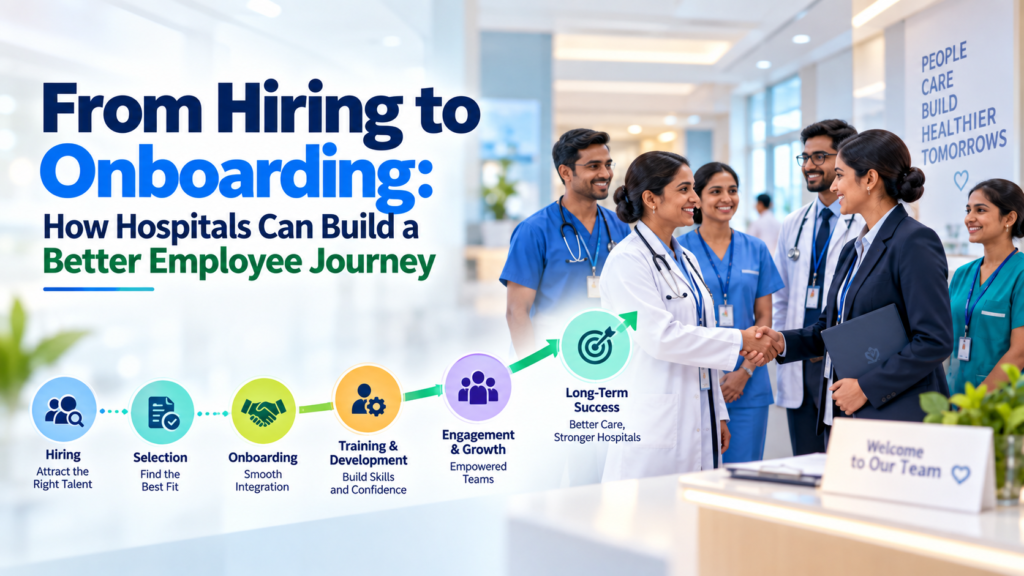
Better Employee Journey starts long before a healthcare professional joins a hospital. It begins when a candidate first discovers the organization, continues through recruitment and interviews, and extends into onboarding, training, and their first experiences at work.
For hospitals, creating a positive employee journey is especially important because healthcare professionals work in a demanding environment where teamwork, communication, and organizational support directly influence day-to-day operations.
A well-planned recruitment process can attract the right candidates, but a Better Employee Journey helps hospitals turn new hires into confident, engaged, and productive team members.
In this blog, we explore how hospitals can improve every stage of the employee journey—from hiring to onboarding and beyond.
What Is an Employee Journey?
An employee journey represents the different stages an employee experiences while interacting with an organization.
For hospitals, this journey can include:
Awareness → Application → Interview → Selection → Offer → Pre-boarding → Onboarding → Training → Development → Retention
Each stage creates an impression about the organization.
If communication is poor during recruitment, candidates may lose interest. If onboarding is unorganized, new employees may feel confused. If training and career development are limited, employees may eventually look for opportunities elsewhere.
Therefore, hospitals should think beyond simply filling vacancies and focus on creating a consistent and supportive employee experience.
Why a Better Employee Journey Matters for Hospitals
Healthcare organizations depend heavily on skilled and reliable employees.
A positive employee journey can help hospitals:
- Attract qualified healthcare professionals.
- Improve candidate experience.
- Reduce recruitment drop-offs.
- Support faster employee integration.
- Improve staff engagement.
- Strengthen organizational culture.
- Reduce avoidable employee turnover.
- Build stronger and more stable teams.
A Better Employee Journey can also strengthen the hospital’s employer brand. Employees who have a positive experience are more likely to speak positively about the organization within their professional networks.
7 Steps to Build a Better Employee Journey
1. Create a Strong First Impression
The employee journey begins before the interview.
Candidates may first discover a hospital through:
- Job portals
- Social media
- Hospital websites
- Employee referrals
- Recruitment agencies
- Professional networks
At this stage, candidates form their first impression of the organization.
How Hospitals Can Improve It:
Hospitals should provide clear information about:
- Job responsibilities
- Required qualifications
- Experience
- Work location
- Department
- Application process
- Relevant benefits and opportunities
A professional careers page and clear job descriptions can make the recruitment experience more transparent.
2. Make the Recruitment Process Simple
A complicated or lengthy recruitment process can discourage qualified candidates.
Hospitals should aim for a recruitment process that is structured but efficient.
A typical process may include:
Application → Screening → Interview → Assessment → Selection → Offer
Candidates should understand what happens at each stage.
Hospitals should also avoid unnecessary communication gaps.
Timely communication demonstrates professionalism and respect for the candidate’s time.
This is an important part of creating a Better Employee Journey from the very beginning.
3. Improve Candidate Communication
Communication is one of the simplest ways to improve the recruitment experience.
Candidates should receive appropriate updates regarding:
- Application status
- Interview schedules
- Required documents
- Selection decisions
- Offer details
- Expected joining date
Even when a candidate is not selected, professional communication can leave a positive impression.
Hospitals should also ensure that recruitment communication is consistent and accurate across HR teams and departments.
4. Make the Offer and Pre-Boarding Experience Smooth
Once a candidate accepts an offer, the employee journey does not stop.
The period between offer acceptance and joining is often called pre-boarding.
During this stage, hospitals can provide:
- Joining instructions
- Required documentation checklist
- Reporting information
- Department details
- First-day schedule
- Contact information
- Basic organizational information
A simple welcome message can also help new employees feel more connected before their first day.
This stage is often overlooked, but it can make a significant difference in creating a Better Employee Journey.
5. Design a Structured Onboarding Program
The first few days and weeks are critical for a new employee.
Simply asking a new employee to report to HR, complete paperwork, and immediately begin work may create confusion.
A structured onboarding program should introduce employees to:
- Hospital departments
- Reporting structure
- Workplace policies
- Job responsibilities
- Safety procedures
- Infection prevention practices
- Communication channels
- Documentation systems
- Relevant training programs
The onboarding process should be tailored to the employee’s role.
For example, onboarding requirements for a nurse may differ from those of a billing executive, technician, or hospital administrator.
6. Provide Role-Specific Training and Support
Hiring the right person is only the beginning.
Employees need the knowledge, tools, and support required to perform their responsibilities effectively.
Hospitals can introduce structured training covering areas such as:
- Department procedures
- Patient safety
- Infection control
- Emergency protocols
- Communication
- Documentation
- Hospital software systems
- Organizational policies
New employees should also have access to a supervisor, mentor, or designated point of contact who can help them during the initial adjustment period.
Continuous support helps employees become confident and comfortable in their new roles.
7. Continue the Journey Beyond Onboarding
A Better Employee Journey should not end after the first week or month.
Hospitals should continue supporting employees through:
- Performance feedback
- Skill development
- Training opportunities
- Career growth
- Recognition
- Employee engagement
- Leadership support
Regular feedback can help employees understand their strengths and identify areas for improvement.
Career development opportunities can also encourage skilled professionals to build a longer-term association with the organization.
Common Employee Journey Challenges in Hospitals
Hospitals may face several challenges while managing the employee journey.
Poor Recruitment Communication
Candidates may experience delays or unclear information during hiring.
Solution: Establish standardized communication processes and timelines.
Unstructured Onboarding
New employees may not know whom to approach or what they are expected to do.
Solution: Create a documented onboarding checklist and orientation program.
Lack of Training
Employees may be expected to learn everything independently.
Solution: Provide role-specific training and department-level guidance.
Limited Feedback
Employees may not receive regular feedback after joining.
Solution: Introduce structured check-ins during the first few months.
Limited Career Development
Experienced professionals may leave if they cannot see future growth.
Solution: Create opportunities for training, specialization, and career progression.
How Technology Can Improve the Employee Journey
Technology can help hospitals make recruitment and onboarding more organized.
Digital HR systems can support:
- Online applications
- Candidate tracking
- Interview scheduling
- Digital documentation
- Offer management
- Employee onboarding
- Training records
- Performance management
An Applicant Tracking System (ATS), for example, can help HR teams monitor candidates throughout the recruitment process.
Digital onboarding systems can also help new employees complete required documentation and access important information before or shortly after joining.
Technology should support the employee experience rather than make processes unnecessarily complicated.
Measuring Employee Journey Success
Hospitals should measure whether their employee experience initiatives are actually working.
Useful indicators can include:
- Candidate drop-off rate
- Offer acceptance rate
- Time to hire
- New employee turnover
- Onboarding completion rate
- Employee satisfaction
- Training completion
- Early-stage performance
- Employee retention
Regularly reviewing these metrics can help HR teams identify where improvements are needed.
For example, if many candidates decline offers, the hospital may need to review its communication, recruitment process, or overall employer value proposition.
How KOUSHALYA Can Support Hospital Recruitment
Building a Better Employee Journey requires more than simply hiring candidates.
Hospitals need a structured approach covering recruitment, selection, onboarding, workforce planning, and employee support.
KOUSHALYA provides healthcare-focused recruitment and consultancy services designed to help hospitals strengthen their workforce processes.
Our support can include:
- Healthcare recruitment
- Candidate sourcing
- Recruitment process improvement
- Staff planning
- Screening and shortlisting
- Interview coordination
- Onboarding process support
- Hospital HR consultancy
A structured approach can help hospitals create a smoother transition from candidate to employee.
Explore our Staff & Recruitment Services to learn more.
Best Practices for a Better Employee Journey
Hospitals can strengthen their employee experience by following a few practical principles:
Keep Communication Clear: Employees and candidates should know what to expect at every stage.
Make Processes Consistent: Standardized recruitment and onboarding processes reduce confusion.
Provide Early Support: New employees should have someone they can approach for guidance.
Invest in Training: Continuous learning helps employees build confidence and skills.
Recognize Contributions: Appreciation can positively influence employee engagement.
Create Growth Opportunities: Career development can support long-term retention.
A consistent approach across these areas can create a Better Employee Journey and help hospitals build stronger teams.
Conclusion
A successful employee experience does not begin on the employee’s first day. It begins when a healthcare professional first interacts with the hospital.
From job advertisements and interviews to offer communication, pre-boarding, onboarding, training, and career development, every stage contributes to the overall employee experience.
Hospitals that invest in a Better Employee Journey can create more positive candidate experiences, support smoother onboarding, strengthen employee engagement, and improve workforce stability.
The goal is not simply to hire employees.
The goal is to attract the right professionals, welcome them effectively, support their growth, and build long-term relationships with them.
KOUSHALYA helps healthcare organizations strengthen recruitment and workforce processes with practical, healthcare-focused consultancy support.
Explore KOUSHALYA’s Staff & Recruitment Services
Frequently Asked Questions
1. What is a Better Employee Journey?
A Better Employee Journey is a structured and positive employee experience that begins during recruitment and continues through onboarding, training, development, and retention.
2. Why is employee onboarding important in hospitals?
Effective onboarding helps new employees understand their responsibilities, workplace procedures, reporting structure, and organizational expectations.
3. How can hospitals improve employee retention?
Hospitals can improve retention through effective onboarding, training, career development, employee recognition, regular feedback, and supportive workplace practices.
4. What role does HR play in the employee journey?
HR helps coordinate recruitment, candidate communication, onboarding, employee documentation, training, performance processes, and other workforce-related activities.
5. Can recruitment consultancy improve the employee experience?
Yes. A specialized healthcare recruitment consultancy can help hospitals create more structured recruitment processes, improve candidate communication, and support workforce planning.