
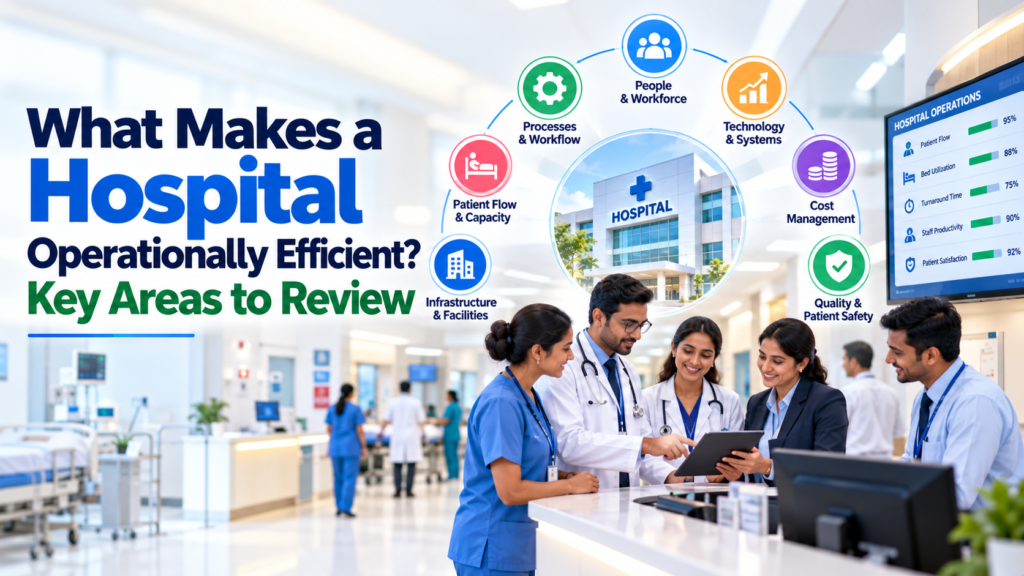
A Hospital Operationally Efficient model is essential for delivering better patient care, improving staff productivity, controlling costs, and creating sustainable healthcare operations. In today’s healthcare environment, hospitals must manage increasing patient expectations, complex clinical processes, staffing requirements, technology, compliance, and financial pressures at the same time.
Operational efficiency does not simply mean doing things faster. It means doing the right things, in the right way, at the right time, with minimum unnecessary delays and resource wastage.
For hospital management, the key question is not only “Are we providing good healthcare?” but also:
“Are our systems and processes helping our people deliver that healthcare efficiently?”
A hospital can have experienced doctors, modern infrastructure, and advanced equipment, but inefficient processes can still result in long waiting times, staff burnout, higher operational costs, poor communication, and reduced patient satisfaction.
So, what should hospital management review?
What Does Hospital Operational Efficiency Really Mean?
A Hospital Operationally Efficient organization has systems that allow clinical and non-clinical teams to work together smoothly.
Operational efficiency can involve:
- Patient flow
- Staff utilization
- Appointment management
- Emergency department processes
- Bed management
- Inventory control
- Billing and insurance processes
- Documentation
- Communication
- Technology
- Quality and compliance
- Facility management
- Patient experience
The objective is to create a healthcare environment where resources are used effectively while maintaining safety, quality, and patient-centered care.
Efficiency should never come at the cost of patient safety or quality of treatment.
1. Patient Flow and Waiting Time
One of the first areas hospitals should review is patient flow.
From registration to consultation, diagnostics, treatment, admission, discharge, and follow-up, every stage should be connected.
Common operational bottlenecks may include:
- Long registration queues
- Delayed consultations
- Diagnostic delays
- Poor coordination between departments
- Delayed discharge
- Repeated documentation
- Unclear patient movement processes
Hospital management should identify where patients spend unnecessary time and understand why those delays occur.
A Hospital Operationally Efficient system continuously monitors patient movement and works to reduce avoidable bottlenecks.
2. Workforce Planning and Staff Productivity
People are one of the most important operational resources in any hospital.
Doctors, nurses, technicians, administrative teams, billing staff, housekeeping teams, and support staff all contribute to the patient journey.
Hospitals should review:
- Staffing levels
- Shift schedules
- Department workload
- Staff-to-patient ratios
- Absenteeism
- Overtime
- Staff productivity
- Training requirements
- Role clarity
Having too few staff can increase workload and burnout, while poorly planned staffing can create unnecessary costs.
The objective should be having the right people, with the right skills, in the right departments, at the right time.
For hospitals facing recruitment or workforce challenges, professional [Staff & Recruitment Services] can help create better workforce planning and staffing systems.
3. Appointment and Scheduling Systems
Appointment scheduling has a direct impact on both patient experience and operational productivity.
A hospital should evaluate whether its scheduling process is:
- Easy for patients
- Easy for staff
- Digitally supported
- Properly coordinated
- Flexible enough for urgent cases
- Designed to minimize unnecessary waiting
Poor scheduling can result in overcrowded departments during certain hours and underutilized resources during others.
A well-designed scheduling system helps hospitals balance patient demand, doctor availability, diagnostic capacity, and facility resources.
4. Emergency Department Efficiency
Emergency departments require particularly strong operational systems because patient needs can change rapidly.
Hospitals should review:
- Triage processes
- Emergency response times
- Availability of critical resources
- Coordination between departments
- Diagnostic turnaround time
- Admission processes
- Discharge or referral procedures
Emergency operations should be regularly evaluated through measurable performance indicators.
In emergency care, operational efficiency can directly influence how quickly patients receive appropriate attention.
5. Bed Management and Capacity Utilization
Hospital beds are valuable operational resources.
Poor bed management can lead to:
- Admission delays
- Emergency department congestion
- Unnecessary patient waiting
- Underutilized beds
- Discharge delays
- Departmental imbalance
Hospital management should monitor:
- Bed occupancy
- Average length of stay
- Bed turnover
- Admission patterns
- Discharge timing
- Department-wise utilization
A Hospital Operationally Efficient approach ensures that available capacity is used effectively while maintaining appropriate clinical standards.
6. Inventory and Supply Chain Management
Hospitals depend on continuous availability of medicines, medical supplies, consumables, equipment, and other essential materials.
Poor inventory management can create two major problems:
Stock shortages can interrupt operations.
Excess inventory can increase costs and wastage.
Hospitals should establish systems for:
- Inventory monitoring
- Minimum and maximum stock levels
- Expiry tracking
- Vendor management
- Purchase planning
- Consumption monitoring
- Department-wise usage analysis
Technology can make inventory visibility significantly easier.
A well-managed supply chain allows hospitals to maintain availability without unnecessarily tying up financial resources.
7. Billing, Insurance and TPA Processes
Financial operations are another important area to review.
Delays in billing, documentation, insurance approvals, or TPA processing can affect both hospital cash flow and patient experience.
Hospitals should evaluate:
- Billing accuracy
- Insurance documentation
- Pre-authorization processes
- Claim submission
- Claim follow-up
- Rejection rates
- Payment timelines
- Patient communication
Efficient [Insurance & TPA Services] can help hospitals improve coordination between patients, insurers, TPAs, and internal billing teams.
Operational efficiency is not complete if clinical operations work well but financial processes remain slow and fragmented.
8. Digital Systems and Technology
Technology should simplify hospital operations rather than create additional complexity.
Hospitals can review how effectively they use:
- Hospital Information Systems
- Electronic medical records
- Appointment platforms
- Digital billing
- Laboratory systems
- Pharmacy systems
- Inventory software
- Reporting dashboards
- Communication platforms
The important question is:
Are your systems actually helping employees make faster and better decisions?
Technology becomes valuable when it reduces repetitive work, improves information access, minimizes errors, and supports better coordination.
9. Standard Operating Procedures
A Hospital Operationally Efficient organization should not depend entirely on individual employees remembering what to do.
Clear Standard Operating Procedures (SOPs) can create consistency across departments.
SOPs can cover areas such as:
- Patient registration
- Admission
- Discharge
- Emergency response
- Infection prevention
- Billing
- Documentation
- Equipment handling
- Inventory
- Complaint management
Good SOPs should be clear, practical, regularly reviewed, and actually followed.
Documentation alone does not create efficiency. The real value comes from implementing the process consistently.
10. Communication Between Departments
Many hospital operational problems are actually communication problems.
A patient may move through multiple departments during a single visit. If information does not move effectively between teams, delays and errors can occur.
Hospitals should review communication between:
- Doctors and nurses
- Clinical and administrative teams
- Billing and insurance departments
- Diagnostics and clinical departments
- Pharmacy and clinical teams
- Front office and inpatient departments
Regular meetings, clear escalation systems, digital communication tools, and defined responsibilities can significantly improve coordination.
A well-connected hospital team can often solve problems before they become major operational issues.
11. Quality, Compliance and Patient Safety
Operational efficiency must always work together with quality and patient safety.
Hospitals should regularly review:
- Infection prevention practices
- Medication safety
- Patient identification
- Clinical documentation
- Incident reporting
- Emergency preparedness
- Quality indicators
- Regulatory compliance
Accreditation frameworks can also help hospitals create standardized systems and improve quality management.
Hospitals looking to strengthen these systems can explore [Accreditations & Compliance Services].
12. Patient Experience
Operational efficiency should ultimately improve the patient’s experience.
Management should monitor:
- Waiting time
- Staff communication
- Appointment experience
- Billing experience
- Discharge process
- Cleanliness
- Accessibility
- Complaint resolution
- Follow-up communication
A Hospital Operationally Efficient system should make healthcare easier to navigate for patients without compromising clinical quality.
Patient feedback can also provide valuable insights into operational problems that management may not see internally.
13. Track the Right Key Performance Indicators
Hospitals cannot improve what they do not measure.
Useful operational KPIs may include:
| Area | Example KPI |
|---|---|
| Patient Flow | Average waiting time |
| Emergency | Response / turnaround time |
| Beds | Occupancy rate |
| Workforce | Staff productivity |
| Diagnostics | Report turnaround time |
| Billing | Billing turnaround time |
| Insurance | Claim rejection rate |
| Pharmacy | Stock-out frequency |
| Patient Experience | Satisfaction score |
| Discharge | Average discharge time |
The objective is not to collect hundreds of numbers.
Instead, hospital management should identify the most meaningful indicators for each department and review them consistently.
Common Signs That a Hospital Needs an Operational Review
Sometimes operational inefficiency becomes visible through recurring problems.
Warning signs may include:
- Patients frequently complaining about waiting times
- Staff regularly working overtime
- Frequent stock shortages
- Delayed discharge
- Repeated billing errors
- High insurance rejection rates
- Poor interdepartmental communication
- Low staff productivity
- Underutilized facilities
- Increasing patient complaints
- Repeated operational mistakes
If the same problem keeps occurring, the solution may not be another temporary fix.
The underlying process needs to be reviewed.
How Hospital Consultancy Can Improve Operational Efficiency
Improving hospital operations requires a structured approach.
A professional healthcare consultancy can help management:
1. Assess Current Operations
Review existing workflows, resources, processes, and performance.
2. Identify Bottlenecks
Find where time, money, staff effort, or resources are being unnecessarily lost.
3. Redesign Workflows
Create practical processes that improve coordination and reduce avoidable delays.
4. Establish KPIs
Define measurable indicators for departments and management.
5. Strengthen Staff Systems
Improve workforce planning, role clarity, training, and accountability.
6. Improve Patient Experience
Connect operational improvements with patient expectations and satisfaction.
7. Create Continuous Improvement
Build a system where processes are regularly measured, reviewed, and improved.
KOUSHALYA provides [Hospital Consultancy Services] designed to support healthcare organizations in improving operations, strengthening systems, and building more sustainable hospital management practices.
A Simple Operational Efficiency Review Framework
Hospital management can use the following framework:
Review → Identify → Measure → Improve → Monitor
Review
Understand how the current process works.
Identify
Find bottlenecks, duplication, delays, and resource wastage.
Measure
Use relevant KPIs to understand the actual performance.
Improve
Redesign processes and introduce practical solutions.
Monitor
Track results continuously and make further improvements when necessary.
This creates a culture of continuous operational improvement rather than one-time problem solving.
Final Thoughts
A Hospital Operationally Efficient organization is not simply one that operates quickly. It is one that coordinates people, processes, technology, resources, and patient care effectively.
Operational excellence requires continuous attention to patient flow, workforce planning, scheduling, emergency care, bed management, inventory, billing, technology, communication, compliance, and patient experience.
In a healthcare environment where expectations are constantly changing, hospitals that regularly evaluate their operations can identify problems earlier, improve resource utilization, support their staff, and deliver a better patient experience.
Operational efficiency is not a destination. It is an ongoing process of measuring, learning, improving, and adapting.
For hospitals looking to strengthen their systems, professional healthcare consulting can provide the structure, expertise, and practical direction required to turn operational challenges into measurable improvements.
Frequently Asked Questions
1. What makes a hospital operationally efficient?
A hospital becomes operationally efficient when its people, processes, technology, resources, and departments work together effectively while maintaining patient safety and quality of care.
2. Which areas should hospitals review for operational efficiency?
Hospitals should review patient flow, workforce planning, appointment scheduling, emergency services, bed management, inventory, billing, insurance, technology, communication, compliance, and patient experience.
3. Why is patient flow important for hospital efficiency?
Efficient patient flow reduces unnecessary waiting, improves resource utilization, supports staff productivity, and creates a smoother overall patient experience.
4. How can technology improve hospital operations?
Technology can reduce repetitive administrative work, improve information access, support scheduling and billing, monitor resources, and provide management with useful operational data.
5. How often should hospitals review their operations?
Operational performance should be monitored continuously, while detailed process reviews can be conducted periodically based on hospital size, department requirements, performance issues, and strategic goals.
6. Can hospital consultants improve operational efficiency?
Yes. Healthcare consultants can assess existing workflows, identify bottlenecks, recommend process improvements, establish KPIs, and support implementation of better operational systems.