
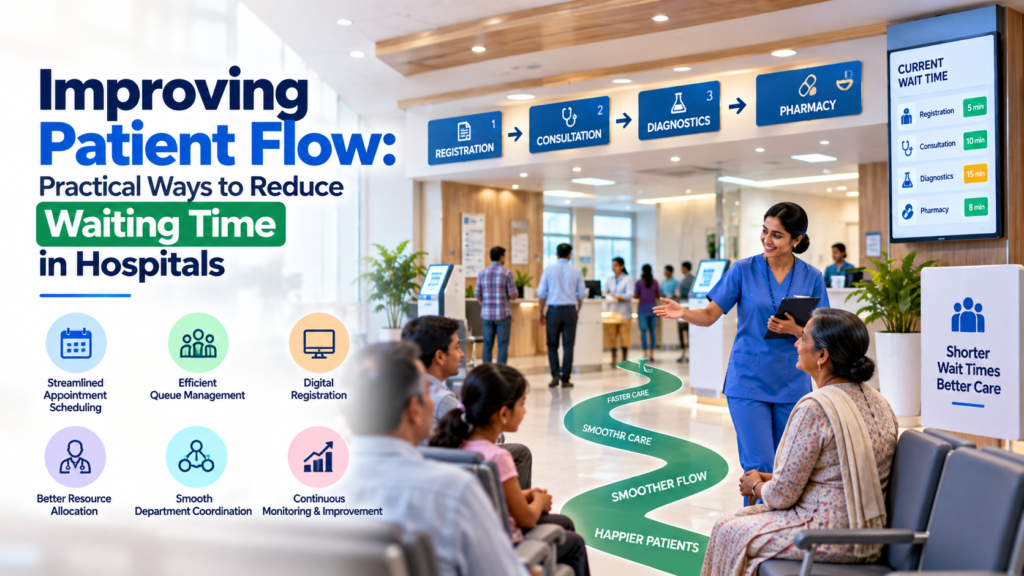
Improving Patient Flow is one of the most effective ways for hospitals to reduce unnecessary waiting, improve resource utilization, support staff productivity, and create a better patient experience. From registration and consultation to diagnostics, admission, treatment, discharge, and follow-up, every stage of the patient journey affects how efficiently a hospital operates.
Long waiting times are more than an inconvenience.
They can create:
- Patient dissatisfaction
- Staff pressure
- Department congestion
- Delayed consultations
- Poor resource utilization
- Appointment backlogs
- Delayed discharge
- Increased operational costs
A hospital may have excellent doctors and advanced facilities, but if patients continuously experience delays, their overall perception of the hospital can still be negative.
This is why Improving Patient Flow should be treated as an operational priority rather than simply a front-office responsibility.
What Is Patient Flow in a Hospital?
Patient flow refers to the movement of patients through different stages of the healthcare journey.
A typical patient journey may look like:
Registration → Waiting → Consultation → Diagnostics → Treatment → Pharmacy/Billing → Discharge → Follow-up
For inpatients, the journey may include:
Admission → Bed Allocation → Clinical Care → Investigations → Treatment → Discharge Planning → Final Billing → Discharge
The goal is not to make every stage faster at any cost.
The goal is to ensure that patients move through each stage smoothly, safely, and without unnecessary delays.
Efficient patient flow means reducing avoidable waiting while protecting quality and patient safety.
Why Do Patients Experience Long Waiting Times?
Before trying to reduce waiting time, hospital management needs to understand why the waiting occurs.
Common causes include:
1. Registration Delays
Manual forms, repeated data entry, or insufficient front-office staffing can create queues.
2. Appointment Overbooking
Too many appointments scheduled during the same time period can overwhelm doctors and departments.
3. Poor Department Coordination
Patients may wait because one department is waiting for information or reports from another.
4. Diagnostic Delays
Limited equipment, staffing, or poor scheduling can increase turnaround time.
5. Bed Availability
Patients may wait for admission because beds are not available or turnover is poorly managed.
6. Delayed Discharge
Patients may remain in beds while waiting for documentation, billing, pharmacy clearance, or insurance processing.
7. Communication Gaps
Patients and staff may not know what the next step is, resulting in confusion and repeated enquirers.
Finding the root cause is the first step toward effective improvement.
1. Map the Complete Patient Journey
The first practical step in Improving Patient Flow is to map the patient’s journey from entry to exit.
Hospital management should document:
Where does the patient enter?
Where do they wait?
What happens next?
Who is responsible?
How long does each stage take?
Where does the process stop or slow down?
This creates a visual picture of the entire workflow.
Once the journey is mapped, management can identify bottlenecks, duplication, unnecessary movement, and avoidable waiting.
2. Measure Waiting Time Instead of Guessing
Hospitals should not rely only on patient complaints to understand delays.
Waiting time should be measured.
Useful measurements include:
- Registration waiting time
- Consultation waiting time
- Diagnostic waiting time
- Pharmacy waiting time
- Billing waiting time
- Admission waiting time
- Discharge waiting time
- Emergency department waiting time
For example:
Patient arrival → Registration: 12 minutes
Registration → Consultation: 35 minutes
Consultation → Diagnostic test: 25 minutes
Diagnostic test → Doctor review: 40 minutes
This data helps management understand exactly where time is being lost.
What gets measured can be improved.
3. Improve Appointment Scheduling
Appointment scheduling has a major impact on patient flow.
Hospitals should analyze:
- Doctor availability
- Average consultation duration
- Peak hours
- Department demand
- Emergency appointments
- Follow-up appointments
- New patient appointments
Instead of scheduling every patient into the same time block, hospitals can create structured appointment slots based on actual consultation patterns.
For example, new consultations may require more time than routine follow-ups.
Better scheduling can prevent overcrowding in waiting areas and improve doctor utilization.
4. Introduce Digital Registration
Registration is often the first major operational touch point.
Digital registration or per-registration can reduce repetitive paperwork and help patients provide information before arriving.
Hospitals can consider:
- Online registration
- Digital forms
- Appointment confirmation
- Automated reminders
- QR-based check-in
- Patient information verification
The objective is simple:
Reduce unnecessary administrative work at the point of arrival.
This can help front-office teams focus more on patient assistance and less on repetitive data entry.
5. Create Separate Queues Where Appropriate
Not every patient requires the same process.
Hospitals may benefit from separate workflows for:
- Scheduled appointments
- Walk-in patients
- Follow-up patients
- Emergency cases
- Diagnostic appointments
- Senior patients
- Special assistance cases
Proper segmentation can prevent one category of patients from unnecessarily affecting another.
However, hospitals should ensure that any queue design remains fair, clinically appropriate, and patient-centered.
6. Improve Coordination Between Departments
Many delays happen because departments work independently.
For example:
A doctor orders a diagnostic test.
The patient waits for the test.
The report is delayed.
The doctor cannot proceed.
The patient waits again.
This creates a chain reaction.
Hospitals can improve coordination through:
- Shared digital systems
- Clear communication protocols
- Department-level escalation
- Real-time status updates
- Defined turnaround times
- Regular operational meetings
The faster information moves, the smoother the patient journey becomes.
7. Focus on Diagnostic Turnaround Time
Diagnostics can become a major bottleneck.
Hospitals should track turnaround time for:
- Laboratory tests
- Imaging
- Radiology
- Pathology
- Specialized investigations
Management should examine whether delays are caused by:
- Equipment availability
- Staffing
- Sample collection
- Transportation
- Reporting
- Communication
Improving diagnostic turnaround can have a positive impact on the entire clinical workflow.
8. Strengthen Bed Management
For inpatient hospitals, bed management is an important part of patient flow.
Hospitals should maintain clear visibility of:
- Available beds
- Occupied beds
- Beds awaiting cleaning
- Beds awaiting transfer
- Expected discharges
- Patients awaiting admission
A centralized bed-management system can help departments coordinate admissions more effectively.
Better bed visibility can reduce unnecessary waiting in emergency and admission areas.
9. Start Discharge Planning Early
One of the most common hospital bottlenecks is late discharge planning.
If discharge planning starts only after the doctor makes the final decision, multiple steps may still be pending.
These can include:
- Discharge summary
- Billing
- Insurance authorization
- Pharmacy
- Investigation reports
- Follow-up instructions
- Patient education
Hospitals can improve flow by identifying potential discharges earlier.
Early discharge planning allows different departments to prepare in parallel rather than sequentially.
10. Improve Insurance and TPA Coordination
Insurance and TPA processes can significantly affect patient flow.
Authorization delays, documentation queries, and final approval processes can delay discharge.
Hospitals should establish clear coordination between:
- Clinical teams
- Billing
- Insurance desk
- Medical records
- TPAs
- Patients and families
Tracking pending approvals and escalation timelines can help reduce unnecessary delays.
For hospitals looking to strengthen this area, KOUSHALYA’s [Insurance & TPA Services] can support better process coordination and revenue-cycle management.
11. Optimize Staffing During Peak Hours
Staffing should match patient demand as much as possible.
Hospitals can analyze patient volumes by:
- Hour
- Day
- Department
- Specialty
- Season
If patient demand is consistently higher during certain hours, hospitals can consider adjusting staffing accordingly.
This applies to:
- Registration
- Nursing
- Diagnostics
- Billing
- Pharmacy
- Housekeeping
- Support services
The goal is not simply to increase staff.
It is to deploy the right number of staff at the right time.
12. Use Technology to Improve Visibility
Technology can help management understand patient movement in real time.
Hospitals can use digital systems to monitor:
- Appointment status
- Queue status
- Bed availability
- Diagnostic turnaround
- Discharge progress
- Billing status
- Pending approvals
Dashboards can help hospital administrators identify bottlenecks before they become major problems.
Technology should not replace human decision-making.
It should provide the information needed to make better decisions faster.
13. Standardize Common Processes
Standardization is essential for sustainable Improving Patient Flow initiatives.
Hospitals should develop clear SOPs for common workflows such as:
- Registration
- Admission
- Consultation
- Diagnostics
- Patient transfer
- Discharge
- Billing
- Emergency escalation
Standard processes reduce confusion and help staff understand their responsibilities.
However, SOPs should remain practical.
A process that looks perfect on paper but cannot be followed during a busy hospital shift will not improve patient flow.
14. Improve Communication With Patients
Waiting becomes more frustrating when patients do not know why they are waiting.
Hospitals can improve the experience through:
- Clear queue information
- Estimated waiting times where feasible
- Appointment reminders
- Staff updates
- Directional signage
- Digital displays
- Clear communication about delays
Even when a delay cannot be completely avoided, good communication can reduce confusion and frustration.
Patient experience is not only about how long someone waits.
It is also about how that waiting experience is managed.
15. Monitor Patient Flow KPIs
Hospitals should establish measurable indicators to track performance.
| Area | KPI |
|---|---|
| Registration | Average registration time |
| OPD | Consultation waiting time |
| Diagnostics | Report turnaround time |
| Emergency | Door-to-assessment time |
| Admission | Admission turnaround time |
| Beds | Bed turnover time |
| Discharge | Discharge turnaround time |
| Billing | Final bill processing time |
| Insurance | Authorization turnaround time |
| Patient Experience | Waiting-related complaints |
Regular KPI reviews help management understand whether improvement initiatives are actually producing results.
Common Mistakes That Can Affect Patient Flow
Hospitals may unintentionally create bottlenecks through:
Overbooking
Scheduling more patients than the department can realistically handle.
Poor Communication
Departments not sharing timely information.
Manual Processes
Using paperwork where digital workflows could reduce duplication.
Unclear Responsibilities
Staff not knowing who owns a particular step.
Reactive Problem Solving
Fixing issues only after complaints occur.
Ignoring Discharge Delays
Focusing heavily on admission while overlooking discharge bottlenecks.
Lack of Data
Making operational decisions without measuring actual waiting times.
Avoiding these problems can create a much smoother patient journey.
How KOUSHALYA Can Support Hospitals
Improving Patient Flow requires more than simply asking staff to work faster.
It requires a structured review of people, processes, technology, resources, and communication.
KOUSHALYA’s [Hospital Consultancy Services] can support hospitals in reviewing operational workflows, identifying bottlenecks, developing practical process improvements, establishing KPIs, and improving coordination between departments.
Support can include:
- Patient journey mapping
- Workflow assessment
- Waiting-time analysis
- Department coordination
- SOP development
- KPI development
- Staff workflow review
- Discharge process improvement
- Operational dashboards
- Continuous improvement planning
Hospitals can also strengthen patient flow by combining operational improvements with [Staff & Recruitment Services], [Insurance & TPA Services], and [Accreditations & Compliance Services].
A Practical Patient Flow Improvement Framework
Hospitals can follow a simple five-step approach:
1. Map
Document the complete patient journey.
2. Measure
Track waiting time at every important stage.
3. Identify
Find the biggest bottlenecks and root causes.
4. Improve
Redesign processes, responsibilities, and workflows.
5. Monitor
Track KPIs continuously and make further improvements.
This creates a continuous improvement cycle:
Map → Measure → Identify → Improve → Monitor
Final Thoughts
Improving Patient Flow is not about making patients move faster through the hospital. It is about removing unnecessary waiting while maintaining safe, high-quality, patient-centered care.
From registration and appointments to diagnostics, admission, billing, insurance, and discharge, every stage of the patient journey can influence the overall hospital experience.
Hospitals that measure waiting times, improve department coordination, optimize staffing, strengthen digital systems, plan discharges early, and communicate clearly with patients can create a smoother and more efficient healthcare environment.
The most successful patient-flow strategies are not based on one major change.
They come from many small improvements working together across the entire hospital.
Better patient flow means better use of resources, less operational pressure, shorter avoidable waits, and a better experience for patients and healthcare teams.
Frequently Asked Questions
1. What is patient flow in a hospital?
Patient flow refers to how patients move through different stages of healthcare delivery, including registration, consultation, diagnostics, treatment, admission, billing, discharge, and follow-up.
2. Why is patient flow important?
Effective patient flow can reduce unnecessary waiting, improve resource utilization, support staff productivity, reduce congestion, and improve patient satisfaction.
3. What causes long waiting times in hospitals?
Common causes include overbooking, registration delays, diagnostic bottlenecks, poor departmental coordination, staffing mismatches, delayed billing, insurance approvals, and inefficient discharge processes.
4. How can hospitals reduce patient waiting time?
Hospitals can reduce waiting through better scheduling, digital registration, workflow redesign, improved department coordination, optimized staffing, faster diagnostics, early discharge planning, and continuous KPI monitoring.
5. How does technology improve patient flow?
Technology can provide real-time visibility into appointments, queues, beds, diagnostics, billing, and discharge status, helping teams identify and resolve bottlenecks more quickly.
6. Can hospital consultants help improve patient flow?
Yes. Healthcare consultants can map patient journeys, identify operational bottlenecks, redesign workflows, establish KPIs, and support implementation of practical improvements.