
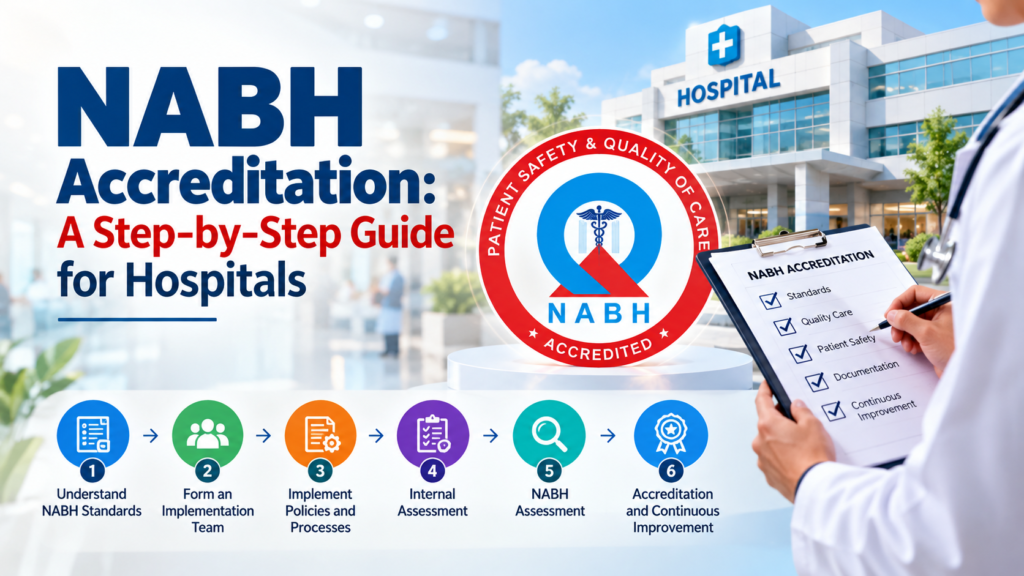
NABH Accreditation is an important quality milestone for hospitals that want to improve patient safety, standardize healthcare processes, and strengthen the overall quality of patient care. For hospitals, accreditation is not simply a certificate; it is a structured approach to improving clinical and operational practices.
Hospitals preparing for NABH Accreditation need to understand the requirements, assess their existing systems, implement necessary improvements, and prepare their teams for assessment.
This step-by-step guide explains the major stages hospitals should consider when working toward accreditation.
What Is NABH Accreditation?
NABH Accreditation is a quality recognition framework for healthcare organizations that evaluates whether a hospital follows defined standards related to patient care, safety, documentation, infection control, medication management, facility management, and other important healthcare processes.
The National Accreditation Board for Hospitals & Healthcare Providers (NABH) operates under the Quality Council of India.
Accreditation encourages hospitals to develop standardized processes, documented systems, continuous improvement practices, and patient-centered care.
For more information, hospitals can refer to the official NABH website.
Why Is NABH Accreditation Important for Hospitals?
Hospitals operate through multiple departments and processes. Without standardized systems, variations in clinical and administrative practices can occur.
Working toward NABH Accreditation can help hospitals focus on areas such as:
- Patient safety
- Quality of clinical care
- Infection prevention and control
- Medication management
- Documentation
- Staff responsibilities
- Facility safety
- Patient rights
- Continuous quality improvement
It can also help hospitals create greater consistency in day-to-day operations.
Step-by-Step NABH Accreditation Process
Step 1: Understand the Applicable NABH Standards
The first step is to understand the standards applicable to the hospital.
Hospital management should review the relevant NABH requirements and identify what needs to be implemented across different departments.
This helps the hospital understand the expected processes before beginning major documentation or implementation activities.
Tip: Do not treat the standards as paperwork alone. The objective should be to build systems that actually work in daily hospital operations.
Step 2: Conduct a Gap Assessment
A gap assessment helps the hospital compare its current practices with applicable NABH requirements.
The assessment may cover:
- Clinical services
- Nursing services
- Infection control
- Pharmacy and medication management
- Medical records
- Human resources
- Facility management
- Biomedical equipment
- Emergency services
- Patient rights
- Quality improvement
The hospital can categorize identified gaps as:
Compliant → Partially Compliant → Requires Improvement
This creates a practical roadmap for improvement.
Step 3: Develop Required Policies and SOPs
Documentation is an important part of hospital quality systems.
Hospitals may need policies, procedures, protocols, and Standard Operating Procedures (SOPs) for relevant activities.
Examples may include:
- Infection control procedures
- Medication management
- Emergency response
- Patient identification
- Incident reporting
- Biomedical waste management
- Fire and safety procedures
- Medical record management
However, SOPs should reflect actual hospital practices. Creating documents that staff do not follow can create problems during implementation and assessment.
Step 4: Implement the Processes
Creating policies is only one part of the journey.
The hospital must ensure that staff understand and follow the implemented processes.
For example, if the hospital has a patient identification policy, the process should be consistently followed in relevant patient-care situations.
Similarly, infection prevention procedures should be implemented in day-to-day clinical activities.
Implementation is where documentation becomes actual practice.
Step 5: Train Hospital Staff
Staff awareness is essential for successful accreditation preparation.
Doctors, nurses, technicians, administrators, housekeeping teams, and other relevant employees should understand the procedures applicable to their roles.
Training may cover:
- Patient safety
- Infection prevention
- Fire safety
- Emergency procedures
- Documentation
- Medication safety
- Incident reporting
- Patient rights
- Quality improvement
Regular training and awareness sessions can help employees understand why a process exists, rather than simply memorizing procedures.
Step 6: Strengthen Quality and Patient Safety Systems
Quality improvement should become part of routine hospital management.
Hospitals can establish appropriate monitoring systems for areas such as:
- Patient safety incidents
- Infection indicators
- Medication-related incidents
- Patient feedback
- Clinical indicators
- Waiting times
- Documentation quality
The hospital should review relevant data and take corrective or preventive actions where necessary.
This creates a cycle of:
Measure → Analyze → Improve → Monitor
Step 7: Conduct Internal Audits
Before an external assessment, hospitals should conduct internal audits to identify areas that need further improvement.
Internal audits can help evaluate whether:
- Staff are following SOPs.
- Required records are maintained.
- Documentation is complete.
- Safety procedures are implemented.
- Quality indicators are monitored.
- Corrective actions are completed.
Regular internal review helps management identify gaps before they become major concerns.
Step 8: Prepare for the NABH Assessment
Once the hospital has implemented the required systems, it can prepare for the applicable NABH assessment process.
Staff should understand their roles and be able to explain the processes they follow.
Preparation should focus on actual implementation rather than memorized answers.
Assessors may evaluate the hospital’s systems, documentation, infrastructure, processes, and implementation across relevant areas.
Step 9: Address Observations and Improve Continuously
The accreditation journey does not end with an assessment.
Hospitals should continue monitoring quality indicators, conducting audits, reviewing incidents, updating processes, and implementing improvement actions.
A successful quality system should become part of the hospital’s everyday culture.
This is why NABH Accreditation should be viewed as an ongoing quality improvement journey rather than a one-time project.
Common Challenges Hospitals Face
Hospitals may encounter several challenges while preparing for accreditation.
Lack of Staff Awareness
Employees may not understand why new procedures are being introduced.
Solution: Conduct role-specific training and regular awareness sessions.
Documentation Gaps
Important records may be incomplete or inconsistent.
Solution: Introduce standardized documentation practices and periodic audits.
Resistance to Change
Employees may initially find new systems difficult to follow.
Solution: Explain the purpose of each process and involve department teams in implementation.
Poor Monitoring
Hospitals may create procedures but fail to measure whether they are working.
Solution: Establish relevant quality indicators and review them regularly.
Last-Minute Preparation
Trying to complete everything immediately before assessment can create unnecessary pressure.
Solution: Develop a phased implementation plan with clear responsibilities and timelines.
How a Hospital Can Prepare More Effectively
A structured approach can make the accreditation journey more manageable.
Hospitals should:
1. Get Management Commitment
Leadership should actively support quality and patient-safety initiatives.
2. Create an Accreditation Team
Assign responsible individuals for different departments and standards.
3. Perform a Detailed Gap Assessment
Identify gaps before developing an implementation roadmap.
4. Prioritize High-Risk Areas
Focus on patient safety, infection control, emergency care, medication management, and other critical areas.
5. Train Employees Continuously
Training should be practical and relevant to each employee’s responsibilities.
6. Monitor Implementation
Use audits, indicators, meetings, and corrective actions to track progress.
How KOUSHALYA Can Support Hospitals
Preparing for NABH Accreditation requires coordination between management, clinical departments, nursing teams, administration, and support services.
Hospitals may benefit from professional consultancy support for areas such as:
- Gap assessment
- Documentation support
- SOP development
- Staff training
- Quality management systems
- Internal audit preparation
- Accreditation readiness
- Compliance improvement
KOUSHALYA provides healthcare consultancy support to help hospitals strengthen their operational systems and work toward improved quality and compliance.
Explore our Accreditations & Compliance Services to learn more.
Final Thoughts
NABH Accreditation can help hospitals create stronger systems for quality, patient safety, documentation, and continuous improvement.
The most effective approach is not to prepare only for an assessment. Instead, hospitals should build processes that are practical, consistently implemented, measurable, and sustainable.
From understanding standards and conducting a gap assessment to training staff, implementing SOPs, performing internal audits, and continuously improving quality systems, every step matters.
With proper planning, leadership commitment, staff participation, and professional guidance, hospitals can make their accreditation journey more structured and effective.
Quality is not a one-time achievement. It is a continuous commitment to better healthcare.
Explore KOUSHALYA’s Accreditations & Compliance Services
Frequently Asked Questions
What is NABH Accreditation?
NABH Accreditation is a quality recognition framework for healthcare organizations that evaluates their systems and processes against applicable standards related to patient care, safety, and hospital operations.
How long does NABH Accreditation take?
The timeline varies depending on the hospital’s size, existing systems, level of preparedness, documentation, implementation, and the applicable accreditation pathway.
Is documentation important for NABH?
Yes. Appropriate documentation helps hospitals demonstrate that relevant policies and processes are defined, implemented, monitored, and reviewed.
Do hospital staff need training?
Yes. Staff awareness and training are important because employees need to understand and follow the processes applicable to their roles.
Can a hospital take consultancy support?
Yes. Hospitals may engage healthcare consultants for gap assessments, documentation, training, implementation support, audit preparation, and other accreditation-related activities.